How to Care for Leather Accessories Properly (And What Most Guides Get Wrong)
A wallet that spends five years in your back pocket will crack before a jacket that hangs in a closet. Same leather. Same brand, sometimes. The difference is friction, sweat, and the fact that nobody ever thinks to maintain something the size of a deck of cards.
That's the gap I want to close here. Most advice about caring for leather accessories properly was written for sofas and car seats: big, flat, stationary surfaces. A belt, a watch strap, a pair of gloves or a cardholder lives a completely different life. It bends a thousand times a day. It absorbs palm oil. It gets shoved into a bag with keys.
So let's talk about what actually keeps small leather goods alive, what quietly destroys them, and why half the internet's advice on conditioning is flat-out wrong.
Key Takeaways
- Small accessories fail from friction and sweat, not from neglect of the surface.
- Condition before you polish, always. Polish sits on top; conditioner goes in.
- Vaseline and olive oil both damage leather over time, for different chemical reasons.
- Heavily used items need conditioning every 3 to 6 months; stored items once a year is plenty.
- Always test any product on a hidden area first, and never dry leather with direct heat.
- The best conditioner depends on the tanning method, not on brand loyalty.
Why your wallet dies before your jacket does
Leather is skin. Not a metaphor—the same collagen structure, just preserved. And like skin, it has pores that open and close, oils that migrate, and a finite tolerance for abuse.
On a jacket, the leather mostly hangs. Gravity is the only stress. On a wallet in your back pocket, you're applying body heat plus 60 to 80 kilos of pressure plus moisture for eight hours a day, five days a week. The fibers compress, the oils get pushed out toward the edges, and the crease line at the fold becomes the first place to crack.
The three real enemies
Here's what actually shortens the life of a small leather item, ranked by how much damage each one does:
- Sweat and salts. Human perspiration is mildly acidic and full of salt. It's the single biggest killer of watch straps and wallet interiors.
- Friction. Keys, coins, the corner of a laptop. Abrasion removes the finish layer long before the leather underneath gives up.
- Prolonged moisture, which is worse than a single soaking. A leather glove that stays damp for two days will stiffen permanently. One that dries properly overnight is usually fine.
I once left a pair of unlined lambskin gloves in a jacket pocket through an entire rainy week. They came out the consistency of cardboard. No amount of conditioner brought the fingers back. Lesson learned, and an expensive one.
Clean, condition, protect: the order matters more than the products
You'll see this sequence everywhere, and for once the internet is right. What nobody explains is why the order is fixed, and what happens if you skip a step.
Step 1: clean off the surface gunk
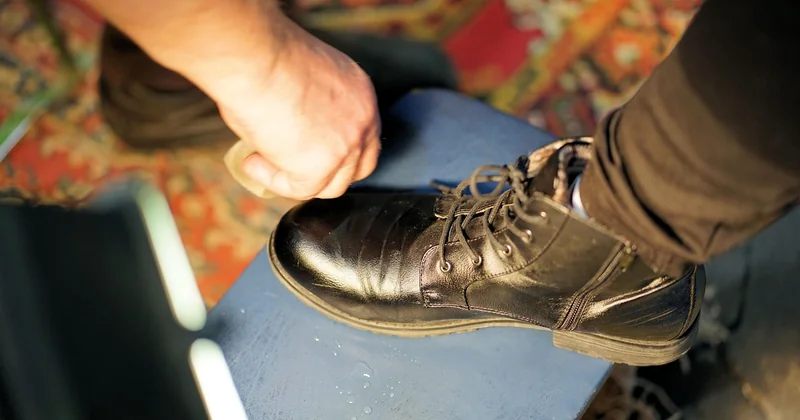
Conditioner cannot penetrate a layer of dust, sweat residue and old product. It just sits there and turns into a sticky film that attracts more dirt. Use a soft horsehair brush for dry dust, then a barely damp cloth with a tiny amount of pH-neutral saddle soap for the grimy parts.
Barely damp. Not wet. A soaked cloth pushes water into the seams, and seams are where leather items rot from the inside.
Step 2: condition while the leather is still cool and slightly open
Apply a small amount with your fingertips or a soft cloth. Work it in circles. Let it sit for 15 to 20 minutes, then buff off the excess. If the leather still feels dry after an hour, repeat—but only once.
Over-conditioning is a real failure mode, and it's the one beginners hit hardest. Too much oil saturates the fibers, the leather goes limp, and it never regains its structure. A belt that was once stiff enough to hold a holster becomes a noodle.
Step 3: protect, if the item warrants it
Not everything needs a protective layer. Finished, chrome-tanned leather—most wallets, most belts—already has a factory finish that does the job. A neutral wax polish on top adds shine and a bit of water resistance. Raw, vegetable-tanned leather (the natural, unsealed kind) benefits from a light wax, but it will darken. That's not damage. That's patina, and it's the whole point.
| Leather type | Typical accessories | Needs conditioning | Avoid |
|---|---|---|---|
| Chrome-tanned, finished | Most wallets, belts, cardholders | Every 4–6 months | Harsh solvents, alcohol wipes |
| Vegetable-tanned, raw | Handmade belts, tooled cases | Every 3 months | Heavy silicone products |
| Aniline / pull-up | Premium bags, some watch straps | Every 2–3 months | Waxes that seal the surface |
| Suede or nubuck | Gloves, some pouches | Rarely, spray only | Creams and oils entirely |
Do you polish or condition leather first?
Condition first, polish second. Every time.
The logic is straightforward once you see it. Conditioner is absorbed into the leather; polish is a coating that sits on the surface. If you polish first, you're sealing the surface with wax and then trying to push oil through a wax barrier. Most of it stays on top, mixed with the polish, and you've wasted both products.
There's a second reason. Polish is often pigmented, and pigment on top of dry, cracked leather highlights every single crack. Condition first, let it absorb, buff, then polish. The pigment goes on smooth and the cracks are far less visible.
One exception: if the item is brand new and already well-conditioned from the factory, you can polish straight away. Give it a month of use before the first conditioning.
Can I use Vaseline to hydrate leather?
No. Please don't.
Vaseline is a petroleum jelly—a mineral oil derivative. It's occlusive by design, which means it forms a barrier on the surface rather than penetrating. On leather, that barrier does two bad things. It clogs the pores, so the leather can't breathe or regulate its own moisture. And it traps existing dirt and sweat underneath, where they keep working on the fibers.
Short term, the leather looks shinier and feels softer. That's the trap. A few months of Vaseline use and the leather starts to feel greasy, then tacky, then brittle as the trapped moisture dries out from underneath the film you've created.
I've seen this on a leather watch strap a reader sent me photos of. Six months of Vaseline, and the strap had a permanent dark sheen and cracks along the buckle holes. It was already gone.
Is olive oil good for oiling leather?
Same answer, different chemistry. Olive oil is a vegetable oil, and vegetable oils oxidize and go rancid over time. On leather, that rancidity shows up as a sour smell, a sticky surface, and a gradual breakdown of the fibers themselves.
It also darkens leather unpredictably. Sometimes dramatically. If you're conditioning a natural tan wallet and you want an even, controlled patina, olive oil will give you blotches.
The one place you'll find vegetable oils used deliberately is in some traditional leathercraft—neatsfoot oil is animal-derived and behaves differently, and there's a long history of olive oil on saddlery in southern Europe. But those applications come with knowledge and control. For a wallet or a pair of gloves, use a product made for leather.
What to do if you've already used either one
Don't panic. Clean the item thoroughly with a pH-neutral leather soap and a slightly damp cloth. Give it a few days to dry naturally, away from heat. Then apply a proper conditioner—a small amount—and work it in. You may not undo the damage entirely, but you'll stop it from getting worse.
What is the best thing to condition leather with?
For my money—and this is the hill I'll stand on—beeswax-based conditioners with lanolin are the best general-purpose choice for small accessories. Here's why.
Beeswax forms a breathable film and adds a bit of water resistance without sealing. Lanolin is a natural wax secreted by sheep, and its chemical structure is close enough to leather's own oils that it absorbs well. Together they condition, protect, and don't leave the greasy residue that pure oil products do.
That said, the "best" product depends on your leather:
- Finished chrome-tanned: a light cream or wax conditioner. Anything from a reputable leather brand will do.
- Vegetable-tanned raw: a beeswax and lanolin blend, or neatsfoot oil in small quantities. Expect darkening.
- Aniline and pull-up: cream conditioner only. No heavy waxes, which will seal the surface and kill the patina effect.
- Suede and nubuck: a protective spray. Nothing else. Not oil, not cream, not soap.
What to look for on the label
Scan the ingredient list. You want animal or plant waxes (beeswax, lanolin, carnauba), natural oils (neatsfoot, mink), and no petroleum derivatives. If the first ingredient is a mineral oil or a solvent, put it back on the shelf.
pH matters too, though most brands don't print it. Leather sits around pH 4 to 5. A conditioner that's strongly alkaline will slowly strip the tanning agents and leave the leather feeling harsh and gray. When in doubt, test on a hidden area—inside a strap, under a belt loop, the inside of a card slot—and wait 24 hours.
The maintenance schedule nobody gives you
Here's the practical version. Print it if you want.
- Daily carry items (wallet, watch strap, belt): wipe with a dry cloth once a week to remove sweat salts. Condition every 3 to 6 months.
- Seasonal items (gloves, scarves): clean and condition before storing, not after pulling them out. They go into the closet already protected.
- Occasional items (formal clutch, briefcase): condition once a year, more often if you notice dryness.
- Anything that got soaked: air dry at room temperature, away from radiators, sunlight and hair dryers. Heat is what cracks wet leather.
And a note on storage. Leather needs to breathe, so cotton dust bags beat plastic every time. If you're storing in a closed box, leave it slightly open. Cramming a wallet against other items in a drawer for months is how corners flatten permanently.
A small confession
For the first couple of years I was into this stuff, I over-maintained everything. Conditioned monthly. Polished weekly. My belts looked great and my wallets felt amazing. Then a leatherworker pointed out that I was basically training them to depend on me—every time I added oil, the leather adjusted, and then it needed more.
You don't build resilience by fussing. You build it by leaving the thing alone most of the time and giving it real care when it actually needs it. Once every season, done properly, beats once a month done nervously.
The items that survive decades aren't the ones that got the most attention. They're the ones that got the right attention, at the right moment, and were left to develop their own character in between.