You can spot a Saint Laurent jacket from thirty feet away. Not the logo — the shoulders. Broad, sharp, almost architectural, sitting on the wearer like a decision rather than a garment. That's not an accident. That's a signature: a set of choices a designer repeats so consistently that the clothes start to speak before the person wearing them does.
Most people searching for "the signature styles of iconic fashion designers" end up on listicles about Audrey Hepburn and the little black dress. That's a different subject. Fashion icons are the people who wear clothes well. Fashion designers are the people who build the vocabulary in the first place. This article is about the second group — the specific recurring moves you can learn to read, and use.
Key Takeaways
- A signature style is a repeated decision, not a mood. Look for recurring shoulder lines, waist placements, fabric choices and closures.
- Chanel's shorthand is tweed plus a rigid, easy silhouette. Dior's is structural. Yves Saint Laurent's is menswear borrowed and sharpened.
- Japanese designers from the 1980s — Rei Kawakubo, Yohji Yamamoto, Issey Miyake — shifted the focus from body-shaping to fabric and volume.
- You can borrow signature logic without copying garments, and it works better than buying replicas.
- If someone asks you to "dress like a fashion designer," they usually mean a specific archetype. Know which one.
What actually makes a signature style?
A designer's signature is built from four repeating notes: silhouette, colour, material and one obsessive detail. Get all four and you have a recognisable body of work. Miss one and you have a wardrobe.
The reason this matters for anyone reading about fashion — not just studying it — is that signatures are the most efficient teaching tool in the discipline. Once you can name what a designer is doing, you stop seeing "a nice jacket" and start seeing a shoulder-width argument, a waist-height decision, a refusal to use buttons.
Silhouette comes first
Ask yourself one question about any designer: where does the fabric sit, and where does it stop? Cristóbal Balenciaga built shapes that hovered away from the body — the 1957 sack dress is essentially a garment that ignores the waist entirely, which was close to scandalous at the time. Karl Lagerfeld, across decades at Chanel, kept the opposite constraint: the jacket sits on the shoulder and stops at the hip, always.
Rei Kawakubo has spent decades at Comme des Garçons refusing the silhouette question altogether. Her collections have produced garments with bumps, lumps and volumes where a body would normally be. When I first saw her work in person at an exhibition, I stood in front of one piece for maybe ten minutes trying to work out how a person got into it. That confusion is the point.
Colour and material discipline
Chanel's palette is famously narrow — black, white, beige, gold, and a pink that exists somewhere between the last two. Yves Saint Laurent leaned on navy, black and red. Halston, in 1970s New York, worked almost exclusively in cashmere, silk jersey, and one shade of red he kept returning to.
Then there's the detail. Coco Chanel had the camellia — a flower with no scent, no thorns, and no season, which is exactly why she liked it. Elsa Schiaparelli had the surreal joke: a shoe worn as a hat, a lobster printed on a dress she made with Salvador Dalí. Yves Saint Laurent had le smoking — a tuxedo cut for a woman, first shown in 1966, which was genuinely transgressive then and is now the default evening option.
The detail is what people remember. The silhouette is what they recognise. Both have to be consistent for a signature to exist.
Reading the major signatures, decade by decade
Here's where it gets useful. Once you lay the designers out in order, you can see that signatures aren't isolated genius — they're arguments with the generation before.
Chanel and the 1920s: getting rid of things
Chanel's contribution is best understood as subtraction. Corsets out. Fuss out. Jersey fabric — previously used for men's underwear — taken seriously. The tweed suit, the cardigan shape, the layered chains: all of it served one goal, which was clothes you could actually move in.
Her skill was making restriction look like freedom. The tweed jacket is comfortable, but it's also rigidly constructed, with a chain sewn into the hem so it hangs correctly. That's the signature trick: apparent ease, hidden engineering.
Dior, 1947, and the New Look
Christian Dior's first collection, presented in 1947, is usually filed under "post-war return to femininity." That description is accurate but misses the mechanics. Dior's innovation was construction: padded hips, a nipped waist, and skirts using enormous amounts of fabric. The "bar" suit — a fitted jacket over a full skirt — was the anchor piece.
What's striking in retrospect is how quickly the silhouette changed the shape of fashion, and how many women found it impractical. Comfort and beauty have been arguing ever since, and Dior is where the argument got loud.
Saint Laurent and the borrowed wardrobe
Yves Saint Laurent's most durable move was taking menswear and cutting it for a woman's body: the tuxedo, the safari jacket, the trench. His tailoring never hid the borrowing — the shoulders stayed sharp, the lapels stayed wide.
He was also, quietly, one of the first major designers to put Black models in a couture setting, and he staged a 1976 collection around Russian peasant dress that shaped a whole aesthetic later recycled by streetwear brands.
The 1980s Japanese wave
| Designer | Signature move | What it rejects |
|---|---|---|
| Rei Kawakubo | Volume, asymmetry, deliberate discomfort | The idea that clothes must flatter |
| Yohji Yamamoto | Oversized black tailoring, gender-neutral cuts | The tailored waist |
| Issey Miyake | Pleating, technical fabric, garment-as-object | Traditional construction entirely |
Notice that none of the three share a colour palette or a market. What they share is a refusal to treat the body as something to be shaped. Miyake's pleating, developed through the 1990s, produces garments that fold flat and hold their shape — a technical achievement as much as an aesthetic one.
What do fashion designers wear?
Almost universally, not their own showpieces. The work of designing requires moving between studios, factories, showrooms and evening events, often in one day.
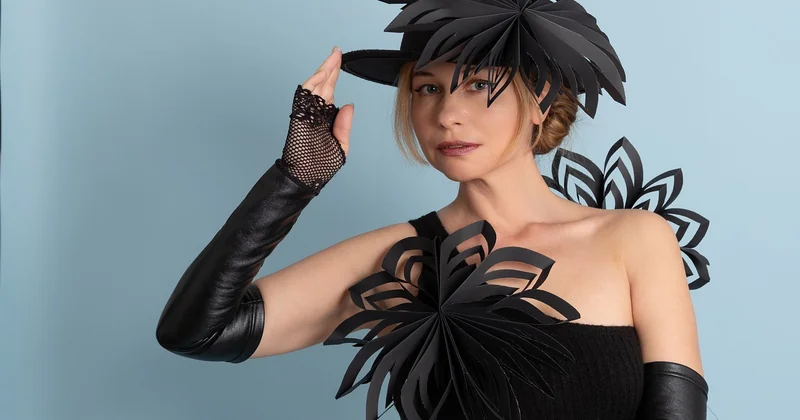
The observable pattern among people who work in the industry is a kind of uniform: dark, layered, and durable. Loafers or boots, a structured jacket, a plain shirt or knit, and one piece strong enough to signal taste without effort. Rick Owens wears his own long, dark lines. Phoebe Philo, when she was running Céline, wore a version of the same outfit every season — white shirt, wide trousers, flat shoes — and it was noticed precisely because it was so consistent.
When someone asks you to dress like a fashion designer for a career day, this is the register they mean: practical, monochrome, one deliberate detail. Not a runway look. A runway look on a random Tuesday reads as a costume.
The three archetypes people actually mean
When someone says "fashion designer outfit," they're usually picturing one of these:
- The studio creative — black layers, rolled sleeves, pins or a tape measure, sneakers you don't mind ruining.
- The established name — tailoring, a single strong accessory, nothing that competes with the clothes being presented.
- The streetwear founder — hoodie or work jacket, vintage reference, one visible brand cue. Think of the trajectory Virgil Abloh traced from Off-White into Louis Vuitton menswear: hoodie logic transplanted into a luxury house.
Pick one and commit. Mixed signals look worse than a plain outfit.
How to borrow a signature without cosplaying
Here's the part most guides skip. Copying a designer's exact garment gets you a look-alike. Copying their logic gets you a wardrobe.
Three ways to do it:
- Pick one silhouette rule and apply it to what you own. If you like Yamamoto's proportions, go one size up on your coat and keep everything beneath it close-fitting.
- Restrict your palette to three colours for a season. Chanel's discipline wasn't poverty of imagination — it was repetition.
- Choose a single repeatable detail. A collar shape, a cuff, a specific kind of button. One is plenty.
I've watched people attempt this and fail in the same way every time: they buy four signature pieces from four different designers and end up with a costume rack instead of a style. The signature only reads when it repeats.
Why signatures still matter
The obvious objection is that fashion moves too fast now for a decade-long signature. Collections come quarterly, trends cycle through social platforms in weeks, and archives are mined constantly.
And yet the designers who last are the ones with a legible, narrow point of view. Demna at Balenciaga spent years pushing an exaggerated, almost hostile silhouette — broad shoulders, oversized hoodies, unsettling proportions — and it registered because it was consistent. Schiaparelli, revived under Daniel Roseberry, works the same way: surreal gold anatomical motifs, drawn directly from the founder's 1930s vocabulary, applied to red-carpet dressing.
That's the actual lesson. A signature isn't a look you arrive at. It's a decision you keep making. The designers worth studying are the ones who made the same decision for twenty years, in public, while the market told them to stop.
Which raises a question worth sitting with: if you had to make one design decision, over and over, for the next decade — what would it be?