You know that feeling when you're getting dressed and something's just off, even though the outfit is objectively fine? Nine times out of ten, that's a jewelry problem. Or rather, the absence of one. Statement jewelry fixes it in about four seconds.
The catch is that "statement" has become a lazy word. It gets slapped on anything bigger than a paperclip. So before you buy a single chunky chain, let's sort out what's actually worth wearing in statement jewelry trends — and what's just noise that'll end up in a drawer by next spring.
I've tested roughly forty pieces over the past two years, made a few expensive mistakes, and landed on a filter that I now apply to every trend before I spend anything. Here's the whole thing.
Key Takeaways
- Scale with intention, not shock value. The strongest pieces of the moment are oversized but sculptural, not simply enormous.
- One statement piece per outfit. Two max if the pieces sit on opposite ends of your body.
- Mixed metals and asymmetric earrings have moved from runway gimmick to genuinely wearable.
- Personalization beats trend-chasing — engraved and initial pieces survive past a season.
- Gold plating is a 12–24 month purchase, not a heirloom. Know which one you're buying before you pay.
- The 2:1:1 rule gives you a fast structure for balancing any look. More on that below.
What's actually happening in statement jewelry right now
Three things changed at once, and they explain almost every trend you'll see this season.
First, silhouettes simplified. Clothing went quiet — a lot of draped neutrals, wide trousers, clean knits — and jewelry took over the job of being interesting. When your outfit is a plain column of fabric, a big piece stops looking excessive and starts looking necessary.
Second, the materials got honest. There's much less appetite for the rhinestone-and-glitter look that dominated a decade ago. Buyers want weight, patina, visible texture. Brass with a deliberate finish. Hammered silver. Matte ceramic. Pieces that look like they were made by a person rather than extruded by a machine.
Third, and this is the one that matters most for your wallet: the pendulum swung back from tiny layered everything toward single, deliberate focal points.
Chunky chains, and the weight test I use before buying one
Thick curb and cable chains are still the entry point for most people, and they're still the easiest trend to get wrong. Here's my filter. Hold the chain in one hand and let it hang. If it dangles like a piece of string, it's a costume piece and it will look like one on your neck. If it drops with a dull, solid thud, you're holding something that reads as intentional.
A solid sterling curb chain sits around $120–$300 depending on width and length. A decent brass or gold-plated version runs $40–$80. There's nothing wrong with the second option, as long as you know you're buying two years, not twenty.
My personal failure here: I bought a two-inch-wide hollow chain because it was affordable and photographed beautifully. It arrived, and I could hear it. Every movement, a faint metallic rustle. I wore it twice.
What is the hottest jewelry trend right now?
Sculptural volume. That's the honest answer, and it's a shift in kind, not just size.
Instead of "add more rhinestones," designers started molding forms: twisted tube hoops, molten-looking cuff bracelets, rings with a deliberately uneven surface that catches the light at odd angles. It's the difference between shouting and speaking with a very low voice.
Practically, it means your most useful purchase right now is probably a single sculpted cuff or a pair of oversized earrings with an irregular shape. Both read as current, both work with a plain outfit, and neither will look dated in eighteen months the way a heavily embellished piece will.
And the market is following this, not the other way around. Independent makers have grown their share of the accessories space noticeably because small-batch casting and hand-finishing produce exactly this look — and the big chains' mass production lines struggle to fake organic irregularity convincingly.
Why this isn't just a "bigger is better" cycle
Every decade gets its oversized moment, but the ones that age well share a trait: the size follows a shape idea. The giant hoop of the 1980s was a geometric statement. A sculpted cuff today is the same logic — the volume is justified by the form.
When size is the only idea, it collapses. You can feel it in the piece even if you can't name it.
Are statement necklaces in style now?
Yes, but not the kind you're probably picturing. The beaded bib necklace and the layered pendant stack have largely finished their run.
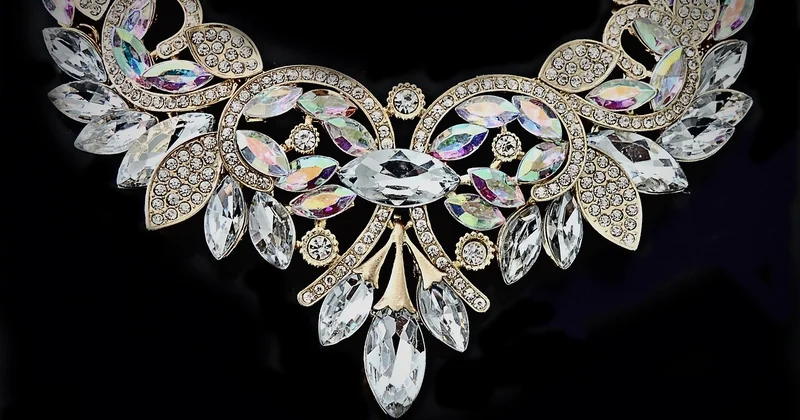
What replaced them is a single collar-scale piece: a wide hinged collar, an asymmetric bar, or a chunky chain worn at the shortest length it will allow. One element, worn close to the throat, doing all the work.
If you already own a statement necklace from a previous era, here's how to tell whether to keep it. Ask two questions. Is the shape readable from three meters away? Does it have a surface quality you'd want to touch? If yes to both, it works now. If it's a cluster of small elements glued into a large shape, it doesn't.
A 30-second decision test for any piece you're considering
- Does the shape hold up at a distance?
- Does the weight feel purposeful, or hollow and rattly?
- Can you name what it's doing to the outfit — or is it just present?
What is the 2:1:1 rule in jewelry?
It's a proportion framework for deciding how many pieces to wear and where. Two small pieces, one medium, one statement. That's the whole rule, and the counting is less important than the zoning.
Here's how I actually apply it. Split your body into four zones: ears, neck, wrist, hands. The rule says you get one statement — exactly one — and the other three zones get restrained pieces.
So: bold earrings, a thin chain, a simple bracelet, no rings. Or the reverse — one sculpted cuff and everything else whisper-quiet. What you never do is put a statement in two zones. That's the version that goes wrong, and it goes wrong in the same way every time: the outfit stops being a look and becomes a display.
How to break the rule on purpose
There's one legitimate exception. If your two statements sit at opposite ends of your body — say, huge earrings and a big cuff — the eye reads them as separate moments rather than a competing cluster. It works. Barely. I've done it successfully maybe a third of the times I've tried.
A practical detail: the rule interacts with your neckline. A statement collar needs bare skin above it. Statement earrings need either short hair or hair pulled back. If you're fighting your own hair or your own neckline, you already lost.
What are the current trends in jewellery?
Beyond volume, four directions are holding up well and are worth your attention.
| Trend | What it looks like | Typical price range | Worth buying? |
|---|---|---|---|
| Mixed metals | Gold and silver in one piece, deliberately clashing | $50–$400 | Yes, if the piece commits fully |
| Asymmetric earrings | Two different shapes on each ear | $30–$250 | Yes, highest impact per dollar |
| Engraved and initial pieces | Stamped letters, coordinates, short words | $60–$300 | Yes, ages best of all |
| Matte and oxidized finishes | Brushed silver, darkened brass, no shine | $40–$350 | Depends on your wardrobe's texture |
Mixed metals deserve a note. The version that works is committed mixing — a piece where gold and silver are both clearly intentional, intertwined or layered as part of the design. The version that fails is the accidental kind, where you just didn't take one of them off.
Asymmetric earrings are the highest-impact thing on this list, in my experience. You get the visual effect of a bold piece with half the weight and half the commitment. A single sculpted earring paired with a small stud costs $30–$60 and completely changes how a plain shirt reads.
Personalization is the quiet winner. Engraved pieces don't chase a season, they just accumulate meaning. I have a hand-stamped bar necklace I've worn perhaps 300 times. It's outlasted every trend piece I've bought.
How to tell a trend piece from something you'll keep
This is the part most advice skips, and it's where the real money is.
Ask what the piece is made of, and be specific about it.
- Solid sterling silver or 14k gold — an heirloom. Costs more, but the cost stops there.
- Gold-filled or heavy plating — a solid multi-year purchase if you treat it well. Avoid perfume and chlorine.
- Standard gold plating over brass — a 12 to 24 month item at best. Fine, if you price it that way.
- Costume base metal — a season. Buy it because you love the shape, not because you expect longevity.
Now the design test. Ephemeral pieces tend to rely on surface: glitter, enamel, a specific motif pulled from a specific runway. Timeless statement pieces rely on form and weight. A hammered cuff could have been made in 1975 or last week — and that's exactly why it still works.
I've reversed my position on this over the years, by the way. I used to think buying cheap trend pieces was smart because you could rotate them. It isn't. You buy four $40 necklaces over two years and you've spent $160 on nothing you'd wear today.
Where this is heading
Two directions seem locked in for the next couple of years.

One is scale with restraint in materials. Bigger shapes, fewer stones, more reliance on metal finish and casting quality. It's less about decoration and more about architecture.
The other is traceable and handmade work. Buyers increasingly want to know who made a piece and what it's made of. Small studios are winning on this, and the effect is that the most interesting statement pieces are often not in the big brand windows at all.
Fall and winter seasons push toward warmer, heavier finishes — oxidized brass, matte gold, darker stones — while spring favors brushed silver and pale ceramic. If you're buying one piece to carry you across both, pick the matte finish. It reads well in every light.
Does the brand name do any of the work?
Less than it used to, in my opinion. The famous houses brought statement jewelry into the mainstream, and that mattered enormously. What they didn't do is invent the sculpted cuff or the asymmetric earring. Those came from independent makers working in small batches, and the mainstream versions arrived afterward.
So the logo is a signal of consistency and service. It isn't a signal that the design is better. I've held $900 designer cuffs that felt lighter and less resolved than a $140 piece from a studio I found by accident.
Where to start without wasting money
If you're building this out from nothing, here's the order I'd go in.
- One pair of oversized earrings in a shape you actually like looking at.
- One sculpted cuff or bangle, sized so it sits just below your wrist bone.
- One chain, solid enough to thud.
- Then stop. Wear those three for two months before buying anything else.
That sequence front-loads the pieces with the highest impact-per-dollar and forces you to learn what you actually reach for. Most people discover their taste is narrower than they thought.
One last thing. The trend cycle keeps shortening, and the pieces that survive it are almost never the loudest ones on the shelf. They're the ones with a shape you can describe in a single sentence. If you can't describe it, you probably won't wear it — and neither will anyone remember it.
So before the next purchase: can you say what it is, in one line, without using the word "statement"?