What happens backstage at a fashion show: the 90 minutes nobody films
Seventeen minutes before a show I worked last season, a dresser discovered that a model's second look was missing a belt. Not misplaced. Missing. The runway was already lit, the front row was seated, and a stylist was quietly sprinting through a corridor with nothing but a strip of black leather in her hand. That belt is what backstage at a fashion show actually looks like.
If you've only seen a fashion show backstage on Instagram—the calm mirror selfies, the soft lighting, the espresso cups—you've seen the press kit. The real operation is a live production line running on a countdown, involving dozens of people you'll never see on camera, and a set of problems that have to be solved in seconds. Here's what's actually going on behind that curtain.
Key Takeaways
- Backstage is a synchronized operation, not a hangout: dressers, seamstresses, hair and makeup teams, stage managers, and security all run on the same clock.
- Most of the visible result depends on 10 to 20 minutes of runway time, but the physical prep behind it can run for days.
- Models don't just walk. They run, change, get re-sewn, and queue in a specific order that a stage manager controls line by line.
- Celebrities in the front row are usually there through relationships and contracts, not appearance fees—though some paid placements do exist.
- What you see on social media backstage is a second, curated production layered on top of the first one.
The backstage machine: who is actually in the room
Walk through the door forty minutes before a show and the first thing that hits you isn't glamour. It's heat. Garment racks packed shoulder to shoulder, extension cords taped to the floor, a makeup artist working under a clip-on lamp that keeps flickering, and someone yelling a name across the room because a shoe size came in wrong.
The room is divided by function, and everyone knows their zone.
- Dressers — one per model in most mid-size shows, sometimes one per two models in tighter productions. They handle every change, every zip, every pin.
- The seamstress and tailor table — the last line of defence. A strap too long, a hem that opens on the walk, a jacket that gaps when the model raises an arm. Fixed on the spot, often while the garment is still being worn.
- Hair and makeup — working in parallel, not in sequence. That's the part people outside the industry always get wrong.
- The stage manager — the person who actually controls the show. Not the designer, not the producer. The stage manager decides when the next look walks.
- Production assistants and runners — the people carrying water, steaming garments, chasing missing accessories, and holding doors.
- Security and press liaisons — filtering who gets near the models, and who doesn't.
Nobody sits down. That's not a figure of speech. In the three hours I've spent inside various backstage areas, I have never once seen a chair used for its intended purpose.
Hair and makeup run in parallel, not in a line
Here's the mechanism most people don't understand. A model isn't finished with hair, then sent to makeup, then sent to wardrobe. All three happen simultaneously across the room, and the model moves between stations based on where the bottleneck is.
Which means the real skill of a backstage lead isn't technical. It's sequencing. You're constantly asking: who is furthest behind, and can I steal five minutes from somewhere else to fix it? When that logic breaks—and it does—you get the classic cascade where one late model delays six others, and the show starts four minutes late.
Four minutes doesn't sound like much. On a runway schedule that's shared with the next brand's load-in, it's a genuine problem.
The mental arithmetic that only insiders know
Ask anyone who has worked a season and they'll tell you the same thing: the show is not the hard part. The hard part is the fifteen minutes immediately before it.

What is the 3-3-3 rule in fashion?
The 3-3-3 rule is a shorthand many stylists and models use to describe the backstage scheduling rhythm: three hours of prep before the doors open, three minutes per model on the runway, and three looks per model in a typical show segment. It's not a formal industry standard written anywhere—you won't find it in a contract—but it reflects how a huge number of shows are actually built. Prep windows, walk times, and look counts tend to cluster around those numbers because they're what the logistics can realistically absorb.
I've seen shows break all three. A couture presentation might give a model one look and eight minutes of prep. A fast-turnaround commercial show might push a model through four changes in ninety seconds. The rule is descriptive, not prescriptive—useful as a mental model, dangerous as a guarantee.
Why do models rarely smile?
Because the walk is a job, and the expression is part of the brief. A model isn't there to look happy—they're there to make the garment read clearly. Smiling pulls focus to the face; a neutral or intense expression pushes it back to the clothing. Some brands explicitly instruct models to walk with a specific mood: cold, playful, blank, aggressive.
There's a practical layer too. During a walk that lasts under a minute, a model is managing their line, their pace, their hands, the fabric, and the turnaround at the end of the runway—all at once. Composing a genuine expression on top of that is hard, and a forced one looks worse than no expression at all. So the industry settled on neutral, and the audience read it as attitude.
How staged is Project Runway?
Substantially. Reality fashion television is built around a production schedule: designers are given time blocks, cameras cover the workroom, and the final runway moment is filmed with retakes and lighting adjustments that a real show would never allow. That doesn't mean the design work is fake, but the clock is a production element. In a genuine backstage, if you're late, the show doesn't wait for a better shot—it just starts, and your look gets cut.
That gap between "filmed fashion" and "live fashion" is exactly what makes real backstage work so tense. There is no second take. There's a runway, a door, and a cue.
The runway order is a live document
Look sheets change. Constantly.
A model's walk order is set the night before and adjusted on the day, sometimes in the final hour. Reasons range from the mundane—an accessory that didn't arrive, a garment that photographs badly under the actual lighting—to the diplomatic: who should walk out before whom, which editors are seated where, which look needs to land right after the music change.
The model's job is to hold all of this in their head while everything around them is loud. Which look is next, which shoe, which earring, whether the jacket is buttoned or open, whether the hair comes down or stays up. Get it wrong and you'll find out on the runway, in front of everyone.
The change: fifteen seconds that decide the whole look
Backstage changes happen in spaces that were never designed for them—behind a curtain, in a corridor, next to a clothes rack, sometimes in full view of a dozen people who are all moving. A model comes off the runway, and the dresser is already there with the next garment open and ready.
The sequence is rehearsed without being rehearsed. Nothing is written down. It's muscle memory built over dozens of shows.
I've watched a dresser re-pin an entire shoulder seam in under forty seconds with the model still wearing the piece. That isn't training from a manual. That's years of repetition.
What the front row actually costs
The front row is a seating chart with political weight. Editors, buyers, stylists, and celebrities are placed by priority, and the placement itself is a message. Which brings us to a question people ask constantly.
Do celebs get paid to attend fashion shows?
Sometimes yes, sometimes no, and the split is roughly by tier. Actors and musicians who already have a relationship with a house—an ambassador contract, an ongoing partnership—usually attend as part of that agreement, which can involve substantial compensation and is often disclosed as a formal brand partnership. Reality personalities and influencers are more frequently paid directly, sometimes in cash and sometimes in product, travel, and styling. A-list film actors with no formal contract often attend as a favour or through their stylist's relationship with the house, without a fee at all.
The important distinction: a paid appearance is a commercial arrangement, and increasingly it has to be labelled as one. An unpaid appearance is a relationship play. Both end up looking identical on the front row.
The second production: backstage as content
Here's the angle that almost nobody outside the industry talks about. A modern show has two backstage operations running at once. The first is the one I described—dressers, steamers, pins, stress. The second is a content operation built specifically to be filmed.
Brands plan which moments get captured: the shoe line-up, the model lineup, a close-up of a makeup artist's brush, a designer's pre-show moment. Those shots are staged, lit, and scheduled around the actual chaos, not extracted from it. What gets posted is real footage of a curated corner of a room that, ten feet away, is currently on fire.
This isn't deception exactly. It's production design. But it explains why your perception of backstage, if you've only seen it through a phone screen, is off by a wide margin. The calm is manufactured. The chaos is the actual product.
The model's side of the hour
Contrary to the fantasy, models spend most of backstage waiting in a state of partial readiness. Half-dressed, hair pinned, phone in one hand, queue number memorized.
Then it moves. Fast.
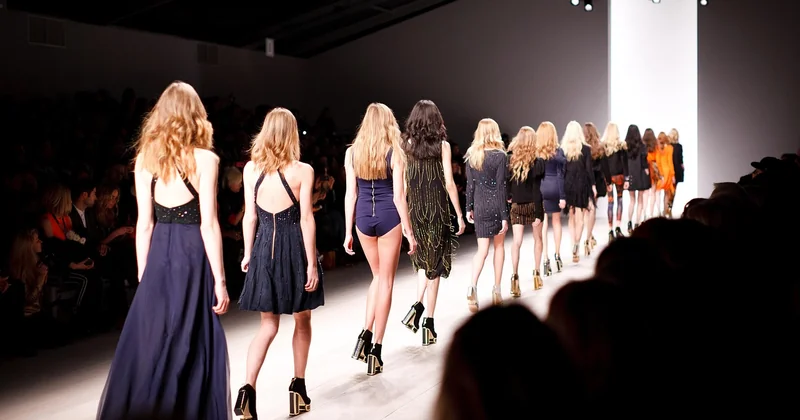
The lineup forms. A stage manager counts heads. Someone checks the order one final time. A door opens onto the runway, and the first model walks out into total silence or total noise—you never know which until it happens.
And the whole room exhales for about three seconds, then goes back to work, because the next look is already waiting.
| What the audience sees | What is actually happening |
|---|---|
| A model walking calmly | Running on adrenaline, tracking order, fabric, and timing simultaneously |
| A flawless, tailored look | Pins, tape, clips, and a seamstress who fixed it forty seconds earlier |
| A front row of relaxed celebrities | A negotiated seating chart reflecting contracts, relationships, and placement priorities |
| Perfect hair and makeup | Two teams working in parallel in a hot room with insufficient mirrors |
| A ten-minute show | Days of prep, hours of rehearsal, and a countdown that never really stops |
The belt gets found
It was in a garment bag, in the wrong rack, three metres from where it should have been.
The model walked out on cue. The look was complete. Nobody in that room will remember the belt in a week, and nobody in the audience ever knew there was a problem. That's the whole job, really—absorbing a hundred small failures so that the only thing anyone sees is a minute of perfect walking.
Which raises a question worth sitting with. If the polished version is what gets filmed, posted, and remembered, and the messy version is where the actual work lives, then what exactly are we admiring when we watch a show? The clothes, sure. But also a group of people who are very, very good at making chaos look like nothing happened at all.