
You know the look: you walk into a Monday meeting wearing earrings that catch the light, and suddenly your entire outfit reads differently. Not louder, exactly. More intentional. The problem is that the same pair that makes a Saturday dinner feel put together can make a Tuesday budget review feel like a costume change gone wrong.
I've been on both sides of that. There was a period when I wore a pair of bold geometric drops to the office every week, and a colleague eventually asked—kindly, but plainly—whether I was heading somewhere after work. That question taught me more about styling statement earrings for work than any fashion magazine ever did.
So here's what actually works: bold earrings can absolutely belong in a professional setting. The trick isn't dialing down the drama. It's matching the earring to the room, the schedule, and the practical realities of a desk job. Get those three right and you can wear pieces with real presence without a single raised eyebrow.
Key Takeaways
- Statement earrings are appropriate at work in most workplaces; what changes is the scale and material, not the concept.
- Match the earring to your dress code: strict formal, business casual, and creative environments call for different weights and silhouettes.
- Practical constraints matter more than most style advice admits: headset use, phone calls, video framing, and noise.
- Neutral metals and matte finishes read more professional than high-shine crystals in conservative offices.
- If a dress code asks you to cover earrings, low-profile studs and small hoops are the clean solution—no need to abandon the idea entirely.
Why statement earrings work in the office—and when they don't
A statement earring does one job: it draws the eye to your face. In a professional setting, that's an advantage. It frames you during a presentation, keeps attention on you during a conversation, and signals that you think about how you present yourself. None of that is unprofessional.
The trouble starts when the earring does more than frame your face—when it becomes a distraction in its own right. Think about the colleague who spends a whole meeting watching a long pendant swing every time you nod. Or the earring that clinks against a phone receiver for forty minutes of a client call. Those are the moments that turn a nice accessory into a problem, and they have almost nothing to do with fashion.
Is it professional to wear earrings at work?
Yes, in virtually every professional setting. Earrings are standard business attire, and most dress codes—even the strictest ones—treat modest earrings as entirely appropriate. The judgment call isn't whether you wear earrings; it's whether the specific pair reads as part of a considered outfit or as a statement you're making on purpose. The first is professional. The second can be, too, in the right room.
The three things that decide it
From experience, the verdict on a given pair comes down to three factors, and none of them is the price tag.
- Weight. Anything heavy enough that you notice it by lunchtime will show on your face by 3 p.m. A tired ear tug is not a professional look.
- Movement. Earrings that swing freely are lovely and terrible for video calls, headset use, and long meetings where you turn your head a lot.
- Noise. Bells, beads, dangles that click together—these are audible. In an open office, they are audible to everyone.
Get those three right and almost any design can work. Get them wrong and even a small pair becomes a liability.
How to style statement earrings by dress code
The single most useful thing you can do is stop thinking "office or not office" and start thinking in three tiers. Most workplaces fall into one of them, and each has a clear ceiling on what reads as polished.
Strict and formal environments
Law, finance, some client-facing roles in consulting—these are the rooms where a bold earring can still work, but the margin is narrow. Your best options are pieces with clean, simple geometry: a striking circle, a bold rectangle, a single strong shape in one metal. Skip anything with loose parts, sparkle overload, or dangling elements below the jawline.
Matte gold and brushed silver look more composed here than high-polish pieces. A short drop that stops just past the lobe is a good ceiling. Anything longer starts to compete with the collar of a blazer and reads as evening wear.
Business casual (which really means "business with room")
This is where the most freedom lives, and where most of us actually operate. Medium-scale drops, sculptural hoops, single-color resin shapes, and textured metal all work. You can go longer and slightly bolder as long as the outfit around it stays calm.
One rule I keep: if the earrings are the loudest thing in the outfit, everything else should be quiet. A plain blouse, a neutral knit, a simple blazer. Let the earring do one job rather than three.
Creative and casual workplaces
Studios, agencies, tech companies, anything with "no dress code" in the handbook—here the ceiling is essentially gone. Mixed metals, sculptural shapes, art-piece designs, mismatched pairs: all fair game. The only constraint is the practical one: no giant dangles on a day of video calls, no metal-heavy pieces during a headset marathon.
| Dress code | Best earring types | Go easy on | Practical note |
|---|---|---|---|
| Strict / formal | Bold single-shape studs, short drops, matte metals | Long dangles, heavy sparkle, loose movement | Keep drops above the jawline |
| Business casual | Medium drops, sculptural hoops, textured metal | Stacked multiple piercings, oversized pieces | Balance with a simple outfit |
| Creative / casual | Statement studs, mismatched pairs, art pieces | Nothing, really—just mind the noise | Watch weight for long days |
The practical rules nobody mentions
Here's where most style advice falls short: it treats the office as a visual space. It isn't. It's a place where you wear a headset for hours, sit in back-to-back video calls, and get tapped on the shoulder in an open-plan room. Earrings have to survive all three, and that changes the calculus.
How to cover earrings at work?
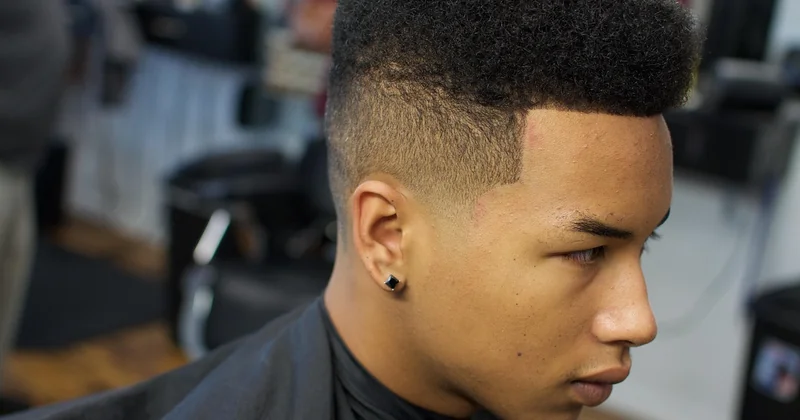
If your workplace or a specific role requires you to cover or remove earrings—some food service, manufacturing, or safety-sensitive environments—the simplest answer is small studs or short huggie hoops, which can be hidden under hair or removed in seconds. Many workplaces allow plain studs, so check what your actual policy says before assuming you have to remove everything. Where physical coverage is required, hair worn down or a scarf can conceal small pieces, but never cover earrings in a way that interferes with safety equipment like headsets or protective gear.
Video calls and headsets
A long dangle disappears below the frame of a typical webcam, which can look odd—like you forgot half your earring. Big hoops near a headset microphone can also catch on the mic boom, and I've heard that metallic click more times than I care to admit. On headset-heavy days, swap to studs or short drops. Keep the statement for days when you're mostly in person.
Weight and wear time
Most statement earrings are not designed for eight hours of wear, and it shows. If a pair starts to ache by early afternoon, it's too heavy for a workday—save it for the evening. Look for hollow or lightweight constructions and thin posts. Your ears will tell you the truth faster than any mirror.
Are statement earrings in style?
Yes—and that's the honest answer, not the diplomatic one. Bold, sculptural earrings have held their place in fashion for years, and the bigger shift has been in how they're worn: less "evening only," more "all day, every day." The styles that read best right now are matte metal, single strong shapes, and slightly oversized studs. Crystals are still fine, but they feel more dressed-up than most offices need.
The trend that matters for work isn't a specific design—it's the attitude. People are wearing their best pieces to the office, not saving them for nights out. That's a shift worth embracing.
Quick styling formulas (gold, silver, and studs)
If you want to skip the theory and just get dressed, here are three formulas that work almost anywhere.
Gold
Warm gold reads softer and more approachable than silver, which makes it forgiving in client-facing roles. Pair a bold gold drop with a cream or navy top and skip other jewelry. One strong gold piece, everything else quiet.
Silver
Cool silver feels sharper and more modern. A brushed silver geometric piece against a black knit is about as close to effortless as office styling gets. Just avoid pairing silver statement earrings with a busy patterned top—the cool tone gets lost.
Studs
If you're new to statement pieces or work in a strict office, start with oversized studs. They give you real presence without any movement, noise, or length problems. A 2-3 cm flat disc in matte metal is a great entry point—bold enough to be noticed, discreet enough to pass anywhere.
The mistake I made early on was buying the loudest pair in the shop and assuming I'd "figure out" how to wear them. I didn't, and they spent a year in a drawer. The pairs that actually got worn were the ones that fit the rooms I was actually in—not the person I imagined I'd be at a gallery opening.
Start where you work. Build outward from there. The boldest earrings you own are only "too much" if they don't match the week you're about to have.