
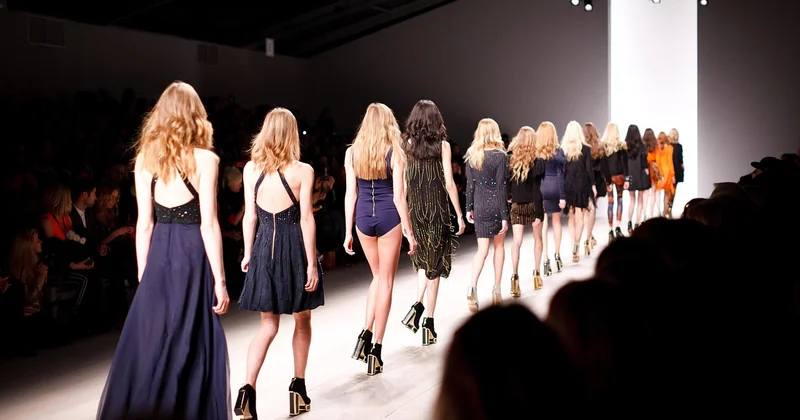
Walk into any Zara or COS in July and you'll find them: the sheer layering, the barrel-leg trousers, the exaggerated shoulder. Twelve weeks earlier, those same ideas walked a runway in Milan and everyone swore they'd never wear them in real life. Yet here we are.
Runway-to-real-life translation isn't a mystery and it isn't magic. It's a filtering process, and once you understand how it works, you stop buying things you'll never wear and start spotting the pieces that will actually survive contact with your Tuesday morning commute.
Key Takeaways
- Runway pieces are concepts, not products — the version that reaches stores is often 3 or 4 iterations removed from what walked the show.
- The 3-3-3 rule is a useful filter for translating a trend into your wardrobe without overcommitting.
- Most trends take 6 to 18 months to move from the runway to mass retail, depending on the price tier.
- You can monitor trends without doomscrolling — a handful of reliable signals beat endless feeds.
- The best translation is rarely the literal piece. It's the proportion, the color, or the styling idea behind it.
How runway trends actually translate to everyday wear
Here's the thing most trend coverage gets wrong: it assumes the runway look travels intact to the store shelf. It doesn't. A concept walks the show, then it gets dismantled and rebuilt for production, buying teams, and price points.
The sheer dress you saw on a runway in February? By the time it hits a mid-market retailer, the fabric has changed (sheer becomes semi-sheer, then opaque with a sheer panel), the cut has loosened, and the price has dropped by a factor of ten. What survives is the idea — a lighter layer over a heavier one — not the garment itself.
What is the 3-3-3 rule in fashion?
The 3-3-3 rule is a practical styling and shopping filter: three colors, three textures, and three accessories per outfit, no more. It's not a law — it's a container. When a trend lands and you don't know how to wear it, the rule stops you from piling on competing statements.
Applied to runway translation, it works beautifully. Take a strong runway theme — say, oversized tailoring with a metallic accent. Instead of buying the full metallic suit, you introduce one metallic element, keep the palette to three colors, and let two neutral textures do the rest of the work. The trend reads. The outfit holds.
Are runway clothes meant to be worn?
Some are, most aren't — and that's by design. Runway collections serve several purposes at once: they communicate a designer's creative direction, they generate editorial coverage, and they act as a research lab for the pieces that will eventually reach stores in wearable form.
The sculptural, impossible-to-sit-in pieces you see photographed are essentially prototypes. Their job is to establish a silhouette, a proportion, or a mood. The commercial versions — the ones that actually get worn — are derived from those prototypes, not copies of them.
So should you wear runway pieces literally? Occasionally, yes, if you find one at a sample sale and it happens to fit your life. But as a general rule, treat the runway as a source of ideas, not a shopping list.
How to monitor fashion trends without losing your mind
Trend monitoring has a dirty secret: most of it is noise dressed up as signal. If you follow everything, you follow nothing.
What actually works is tracking a small number of leading and confirming signals. Leading signals come from the runway and from what stylists, editors, and early-adopting buyers are wearing six months before anything hits the high street. Confirming signals come from retail — what's suddenly on the front tables at three or four different price points.
The signals that actually matter
- Runway repetition. If the same idea appears across four or more unconnected shows in a single season, it's a trend, not a designer's quirk.
- Retail velocity. Watch when mid-market brands start stocking a silhouette — that's the moment a trend is genuinely available, usually 6 to 12 months after the show.
- Street saturation. By the time you see a trend on every second person in your city, it's either fully mainstream or already on its way out. Useful to know, less useful to buy into.
- Editorial recurrence. If a shape keeps showing up in shoots with no obvious commercial tie-in, it's usually a designer-led idea with staying power.
A practical watching routine
You don't need to consume runway content daily. Once a season is enough. Skim the show reports from the four fashion capitals, note two or three recurring ideas, and then wait. Six weeks later, check whether those ideas have started appearing in retail drops. If they have, you now have a shortlist. If they haven't, they were probably editorial-only — interesting, not wearable.
One habit I've found genuinely useful: photograph street style you like and sort it after a month. Patterns emerge fast, and you'll spot your own taste more clearly than any trend report will show you.
Runway vs. retail: what changes, and why
The transformation from runway to retail follows a fairly predictable pattern. Understanding it lets you predict what you'll actually be able to buy.
| Element | Runway version | Retail version | Typical lag |
|---|---|---|---|
| Fabric | Sheer, structured, often unlined | Semi-sheer or opaque, lined | Immediate at luxury tier |
| Cut | Exaggerated, sculptural | Softened, more forgiving | 6-12 months |
| Color | Full palette, sometimes extreme | 2-3 commercially safe variants | Immediate at mid-market |
| Price | Designer, high four to five figures | Mid-market, often under £200 | 12-18 months |
| Styling | Fully art-directed | Sold as separates | Immediate |
The pattern is consistent: the more extreme the runway element, the more it softens in translation. What rarely survives is volume — extreme proportions get trimmed because they're hard to fit and expensive to produce at scale.
What makes a woman look wealthy?
The honest answer: fit, fabric, and restraint. Not logos, not price tags. A well-tailored coat in a substantial wool reads more expensive than a designer bag paired with a poorly-fitted outfit.
Runway translation is relevant here because it explains the mechanism. The "quiet luxury" look that dominates so much of what's currently in stores isn't a return to modesty — it's the retail version of a runway idea that emphasized proportion, material quality, and neutral palettes. The version that reaches the high street keeps the palette and the proportions but often loses the fabric quality. Which is why two women can wear nearly identical outfits and look completely different in them.
If you want the effect, buy fewer pieces and buy them in better fabric. A single well-cut blazer in a heavy wool will outperform five trend pieces every time.
A filter for deciding which trends to actually adopt
Not every runway trend deserves a place in your wardrobe. Here's a simple filter I use and recommend:
- Does it fit an outfit you already own? If a new piece needs two more purchases to work, skip it.
- Can you wear it in at least three different contexts? Work, weekend, evening. If it only works for one, it's a costume.
- Is the trend about a proportion or a specific garment? Proportion trends (barrel legs, cropped jackets) are easier to adopt cheaply than garment trends.
- Does the retail version match the runway version? If the answer is "not remotely," the trend may not be for you.
- Would you still wear it if it weren't a trend? This is the question that separates wardrobe from clutter.
Applied properly, this filter usually eliminates at least half of the trends you were tempted by. That's not a failure — that's the system working. The trends that survive the filter are the ones you'll wear for years rather than one season.
The part nobody tells you
Runway-to-real-life translation isn't about following rules — it's about learning which rules apply to you. Two people can look at the same runway show and come away with completely different, equally valid translations, because their wardrobes, bodies, and lives are different. The trend is the raw material. What you build with it is yours.
So the next time a season lands and everyone's talking about a silhouette you're not sure about, don't ask "should I wear this?" Ask instead: what's the smallest version of this idea that I'd actually reach for on a normal Tuesday? If you can answer that, you've already made the translation. If you can't, the trend wasn't for you — and that's fine. Most of them aren't.